Tuesday, September 28, 2010

Old Field Ecosystem

Autumn Olive

Order:Rhamnales
Family:Elaegnaceae
Genus:Elaeagnus
Species:E. umbellata

Identifying Characteristics: Alternate leaves that are darker green on top and silvery on top. Fruit is red with small silver polka dots on the fruit.

Special Adaptations: Invasive Species.

Closed Gentian

Order:Gentianales
Family:Gentianaceae
Genus:Gentiana
Species:G. andrewsii

Identifying Characteristics: Rich blue to purple colored, bottle shaped flowers with closed mouths. Flowers are clustered at the top of the plant. Leaves are whirled or opposite.

Special Adaptations: Large regional distribution. Can grow in many different soils as well as shade conditions.

Ebony Spleenwort

Order:Polypodiales
Family:Aspleniaceae
Genus:Asplenium
Species:A. platyneuron

Identifying Characteristics: Small fern, similar to Christmas Fern. Main difference is that the stem is a dark ebony to black color. Leaves are arranges alternately along stem with 15-14 leaflets on each compound leaf.

Special Adaptations: Prefers dappled to partial sunlight, moist to dry conditions, and lo
amy to rocky soil conditions.

Wild Red Raspberry

Order:Rosales
Family:Rosaceae
Genus:Rubus
Species:R. idaeus

Identifying Characteristic: Perennial plants with large pinnate leaves with 3-7 serrated leaflets, green above and nearly white below.

Special Adaptations: Sun and water are essential for growth.

New England Aster

Order:Asterales
Family:Asteraceae
Genus:Symphyotrichum
Species: A. novae angliae

Identifying Characteristics: Alternate, oblong, lance shaped leaves. Purpleish flower with many small, thing, long petals around a yellow center. Leaves are not toothed, which is a way to tell it apart from other asters.

Special Adaptations: Grows in moist soils along lakes, streams, roadsides and railroads.

Lance-leaved goldenrod

Order:Asterales
Family:Asteraceae
Genus:Solidago
Species:S. lancifolia

Identifying Characteristics:2 1/2-3 ft. tall. Alternate lance shaped leaves with smooth edges. Fine white hairs on the stems. Clusters of small yellow flowers at the top of the apex of the plant.

Special Adaptations: Prefers moist soils and full sunlight, but is surprisingly drought
tolerant.

Yarrow/Molfoil

Order:Asterales
Family:Asteraceae
Genus:Achillea
Species: A. millefolium

Identifying Characteristics: Leaves are evenly distributed along the stem. Leaves near middle or bottom are the largest and look similar to small ferns. Leaves are 5-20 cm long, bipinnate or tripinnate and almost feathery and arranged spirally on the stem. There are disks of flowers at the top of the stem that are white to yellow in color.

Special Adaptations: Draught Tolerant.

Tall or Giant Sunflower

Order:Asterales
Family:Asteraceae
Genus: Helianthus
Species:H. Giganteus

Identifying Characteristics:Grows up to 4 meters tall. Leaves are slender and lance shaped. The flower heads are bright yellow and up to 7 cm across.

Special Adaptations: Grows best in moist soils, but can adapt dryer soils.

Wednesday, September 15, 2010

Bog Ecosystem

Mapledust Lichen

Order:
Family:
Genus:Lecanora
Species:L. thrysanophora

Identifying Characteristics: Green crustose lichen that grows on trees. Usually surrounded by a band of white.

Special Adaptations: Usually grows on maple trees.

Bleeding Fairy Helmet

Order:Agaricales
Family: Mycenaceae
Genus:Mycena
Species:M. haematopus

Identifying Characteristics: Bodies appear in clusters on decaying logs, trunks, and stumps of deciduous trees, preferably beech trees. Reddish cap and stem with white gills. "Bleeds" when they are cut or broken.

Special Adaptations: Grows only on wood that is already decaying, unlike other mush
rooms.

Whitewash Lichen
Order:
Family:
Genus:Phlyctis
Species:P. argena

Identifying Characteristic: Crustose Lichen. Looks like white washing paint on the tree that it grows upon.

Special Adaptations:

Blackdisk Fungi

Order:Lecanorales
Family:Physiceae
Genus:Buellia
Species:B. nigra

Identifying Characteristics: Small black disc-like fungi growing in clumps upon dead and decaying trees. Looks almost like a lichen.

Special Adaptations:

Brown-Eyed Rim Lichen

Order:
Family:
Genus:Lecanora
Species:L. allophana

Identifying Characteristics: Crustose Lichen. Whiteish orangeish colored. Growing on trees.

Special Adaptations:

Orange Fairy Cup

Order:Pezizales
Family:
Genus:Aleuria
Species:A. aurantia

Identifying Characteristics: Medium to large, bright orange to brilliant yellow, thin, brittle cup. Small white hairs seen in hand lens. Grows in clusters.

Special Adaptations: Grows on disturbed or clay soils.
Cricket (field?)
Order:Orthoptera
Family:Gryllidae
Genus:
Species:

Identifying Characteristics: Dark brown or black cricket with loud chirping sound coming from males.

Special Adaptations: House themselves in small cracks in order to keep warm. Lay eggs before it gets cold, uses its chirp in order to attract a female mate.

Swamp Dewberry

Order:Rosales
Family:Resaceae
Genus:Rubus
Species:R. hispidus

Identifying Characteristics: Grows in soils in swamps, wet forests, thickets. Small white flowers with 5 petals. Twig is red and bristled. 3 bright green leaves, somewhat toothed.

Special Adaptations: Can survive in temps. as low as -38 degrees F. Can also live in soils with a Ph between 4.5-7. Needs lots of oxygens, sunlight and moist soils in order to grow.


Sunday, August 22, 2010

Savannah Species List

Pearl Crescent

Order:Nymphalidae
Family:Nymphalinae
Genus:Phyciodes
Species: P. tharos

Identifying Characteristics: Upperside is orange with black boarder, crossed with fine black marks. Underside of hindwing had dark marginal patch containing light colored crescent. Wingspan 3.2-4.5 cm.

Special Adaptations: Males patrol open areas for females. Eggs laid on underside of host plant leaves. Large range and habitat.

Eastern Tailed Blue

Order:Lycaenidae
Family:Polyommitinae
Genus: Cupido
Species: C. comyntas

Identifying Characteristics: One narrow tail on hindwing. Upperside of male, iridescent blue. Summer females usually brown, spring females smaller with much blue on base
s. Underside of wing pale blue with black bar, distinct black spots and 3 large orange spots on outer margin near tail. Wing Span 2.2-2.9 cm.

Special Adaptations: Males patrol near host plants during daylight hours. Females lay eggs on flower buds, caterpillars eat buds, seeds, and flower.

Clouded Sulphur

Order:Pieridae
Family:Coliadinae
Genus: Colias
Species: C. philodice

Identifying Characteristics: Upper surface of males wings bright clear yellow with solid black edging, lower side of forewing with some dark submarginal spots, hindwing with silver cell spot rimmed with orange-pink usually doubled. Females have 2 forms: yellow form with uneven black edging, enclosing yellow spots, and a white form which is greenish-white rather than yellow. Wing Span: 3.8-7 cm.

Special Adaptations: Very large range and habitat. Egg laid singly on hosts, caterpillars eat leaves.

Hackberry Emperor Butterfly:

Order:Nymphalidae
Family:Apaturinae
Genus: Asterocampa
Species: A. celtis

Identifying Characteristics: Varies geographically. Upperside is reddish brown. Forewing has one submarginal eyespot, a jagged row of white spots and and a cell that has one solid black bar and two separate black spots. Wing span: 3.5-6.3 cm. Fly is fast erratic manner and rest upside down on tree trunks.

Special Adaptations: Males perch on tall objects in sunny areas to watch for females. Eggs laid in clusters and caterpillars feed communally. Caterpillars overwinter in groups gathered inside dead rolled leaves.

Indian Grass:

Order:Cyperales
Family:Poaceae
Genus:Sorghastrum
Species:S. nutans

Identifying Characteristics: Perennial grass that is 3-7' tall. Tight bunches of flowering clums and their leaves. Clums are light green to pale yellow. Blades are alternate leaves up to 2' long, dull to dark green, flat and hairless.

Special Adaptations: Dominant grass of prairies in historical times. Often used for tallgrass prairie restoration.

Flowering Spurge

Order:Euphorbiales
Family:Euphorbiaceae
Genus:Euphorbia
Species: E. corrolata

Identifying Characteristics: 1/2-3' tall. Central stem in light green and hairless. Leaves are hairless, 1-2" long and 1/2" wide broadly linear or narrowly oblong with smooth margins. Alternate along the stem except at the apex where they occur is whorls of 3 beneath the flowers. Each flower contains a yellow cyanthium of very small yellow flowers which is surrounded by 5 petal like structures that are white.

Special Adaptations: Can be found in a wide range of habitats. Attract wasps, flies, and bees.

American Hogpeanut
Order:Fabales
Family:Fabaceae
Genus:Amphicarpaea
Species:A. bracteata

Identifying Characteristics: Viney, spreading to 5 feet. Flowers are tubular like and is pink to white. Leaves have 3 leaflets and are alternate on stem. Hairy stem.

Special Adaptations: Edible flowers, stems, seeds and leaves.

Common Evening Primrose

Order:Myrtales
Family:Onagraceae
Genus:Oenothera
Species:O. biennis

Identifying Characteristics: Alternate lance shaped leaves, that look similar to willow leaves, usually on a central stem, but there can be other stems off of that. Stems are light green or red and covered with white hairs. 4 yellow flowers. Likes full sun and somewhat sandy soil.

Special Adaptations: Favors disturbed areas.


Thursday, August 12, 2010

Shrub Carr Ecosystem

Eastern Wood Peewee

Order:Passeriformes
Family:Tyrannidae
Genus:Contopus
Species:C. virens

Identifying Characteristics: Adults are grey-olive on upperside and light on underside with olive color
ing on breast. Whitish wingbars. Call is a "peee-a-weeee".


Special Adaptations: Very large habitat.

Softleaf Arrowwood

Order:Dipsacales
Family:Caprifoliaceae
Genus:Viburnum
Species:V. molle

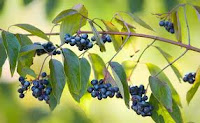
Identifying Characteristics:Leaves broadly egg shaped or heart shaped, toothed, soft hairy beneath. Fruits are small and dark blue with a single ridge. Twigs hairless.


Special Adaptations:No other arrowwood has hairy, heart shaped, toothed leaves.


Question Mark Butterfly

Order:Lepidoptera
Family:Nymphalidae
Genus:Polygonia
Species:P. interrogationis

Identifying Characteristics: The silver mark on underside of hindwing is broken into two parts and looks like a question mark. Upperside of wing is red-orange with black spots. Live in wooded areas with some
open spaces.

Special Adaptations: Most adults will stay in Northern U.S. to hibernate while others will migrate.

Black Capped Chickadee

Order:Passeriformes
Family:Paridae
Genus:Poeile
Species:P. atricapillus

Identifying Characteristics: Black cap and bib, white cheeks, grey back, wings, and tail, and whitish underside with buffy sides. Short neck and large head. Long, narrow tail and a short bill. Mostly found in forests.

Special Adaptations: Considered year long residents, but some may wander during the fall b
ecause of food shortages.

Longhair Sedge

Order:Cyperales
Family:Cyperaceae
Genus:Carex
Species:C. Comosa

Identifying Characteristics: Smooth growing up to 5' high. Flat leaves that are mid to dark green. Produces yellow flowers that bloom in spring and summer. Grows in wetlands.


Special Adaptations: Grows in shallow water with lots of sunshine.

Soft Rush
Order:Juncales
Family:Junaceae
Genus:Juncus
Species:J. effusus

Identifying Characteristics: Grass like growing up to 3 and 1/2 feet high. Stems are dark green, soft, round, with dark lines, and sharp tips. Flowers in single clusters near the middle of the stem. Grow in shallow water or moist soils.

Special Adaptations: Provide habitat for micro and macro invertebrates.

Raccoon

Order:Carnivora
Family:Procyonidae
Genus:Procyon
Species:P.lotor

Identifying Characteristics: Greyish fur with black mask on face. 5 digit paw with no webbing.

Special Adaptations: Can stand on hind legs, swim, climb, and have a dual cooling system to regulate their body temperature.

Bitter Nightshade

Order:Solanales
Family:Solanaceae
Genus:Solanum
Species:S. dulcamara

Identifying Characteristics:Climbing plant. Leaves are 2-4 inches long, some entire, others having 3 lobes. Flowers are purple. Fruit is oval, red, and juicy and have many seeds.

Special Adaptations: Can block out other plants from sunlight due to its vineyness.

Cardinal Flower

Order:Campanulales
Family:Campanulaceae
Genus:Lobelia
Species:L. cardinalis

Identifying Characteristics: Scarlet flowers. 1-11/2 in long. Leaves are alternate and toothed. 5 petals, 5 stamen.

Special Adaptations: Depends on hummingbirds for pollination.


Sunday, August 8, 2010

Swamp Ecosystem

Black Willow

Order: Salicales
Family:Salicaceae
Genus:Salix L.
Species: Salix nigra

Identifying Characteristics: Leaves are alternate, long, and slender.
Leaves are ab
out 5-10 cm long and droop a bit. Bark is brown to blackish and somewhat scaley.

Special Adaptation: Grow in many types on soil, but its shallow roots need abundant moisture. Most
commonly found near water and in swamps.

Wood Frog

Order:Anura
Family:Ranidae
Genus:Rana
Species:Rana sylvatica

Identifying Characteristics: 2 in. -2.8 in long, females usually longer than
males. Adults
are usually brown, tan or rust colored and usually have a dark eye mask. Underside of frogs is usually pale with a yellow or green cast.

Special Adaptations: Large range due to its freeze tolerance.

Zoned Cork Hydnum

Order:
Family:
Genus: Phellodon
Species:Phellodon tomentosus

Identifying Characteristics:Thin, brown cap, flat or shallowly depre
ssed. Surface velvety. Cap may be pale dingy yellow on margin to dark brown towards center.

Special Adaptation: Cap turns black in KOH(potassium hydroxide) and and grey to black in FeSO4(iron sulfate).


Slippery/Red Elm

Order:Rosales
Family:Ulmaceae
Genus:Ulmus
Species: Ulmus rubra

Identifying Characteristics: Leaves are 10-18cm long and have a rough t
exture, coursely double serrated margin, and oblique base. Hairy buds and twigs. Easily identified from Am
erican Elm by looking at bark sample. Bark cut will be red instead of having red with white lines like in the American Elm. Grows in moist soils next to water or in wetlands. Medicinal.

Special Adaptations: Elastic and shock resistant. Less susceptible to Dutch Elm Disease

.

Eastern American Toad

Order:Anura
Family:Bufonidae
Genus:Bufo
Species:Bufo americanus americanus

Identifying characteristics: Usually some shade of brown. Has 1-2 warts on its dark spots. Have chests that are cream or white colored with spots.

Special Adaptations: Often stay in one area where temperatures are cool, there is loose soil, and abundant food.
Clearweed

Order:Urticales
Family:Urticaceae
Genus:Pilea
Species:Pilea pumila

Identifying characteristics:Stems are smooth, round, hairless, and translucent. Leaves are opposite, ovate, hairless and coarsely serrated. The upper surface is dark green while the lower surface is light green or almost white.

Special Adaptations: Found in many different areas, but t
ypically in moist woodlands.

Jewelweed

Order:Geraniales
Family:Balsaminaceae
Genus:Impatiens
Species:Impatiens capensis

Identifying Characteristics: Leaves are elliptical or triangular and are slightly toothed. Leaves are bluish green in color with a whitened underside. Flower is bright orange to red and forms a triangular tunnel. Found in moist, shaded areas.

Special Adaptations: Relieves itching from poison ivy, oak, stinging nettle and insect bites.

Dryad's Saddle Fungus

Order:Polyporales
Family:Polyporaceae
Genus:Polyporus
Species:Polyporus sqamosus

Identifying Characteristics: Stick out of shelves at lower part of dead tree trunks with its thick stem. Body is yellow to brown and has scales on its upper side. Cap is depressed in middle. On the underside there are many pores. Commonly found on dead elm trees and living maples.

Special Adaptations: Plays an important part in woodland ecosystem because it decomposes many dead trees.

Saturday, July 31, 2010

Marsh Ecosystem

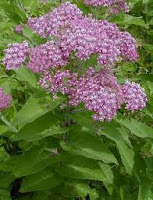
Swamp Milkweed

Order:Gentianales
Family:Asclepiadaceae
Class: Asclepias L.
Genus:Asclepias incarnata L.

Identifying Characteristics: Opposite, long narrow, lance shaped leaves with sharp pointed ends. Plants bloom in mid-summer and
produce a small, fragrant, pinkish-purpleish flowers in rounded umbrels. Whit
e sap that comes from leaf when broken.

Special Adaptations: After blooming, green seed pods are produced. When they are ripe, they will split open and release flat seeds attached to silky white hairs that catch the wind and make it easy for seed dispersal.

Swift Long Winged Skimmer

Order:Odonata
Family:Libelluidae
Genus:Pachydiplax
Species:Pachydiplax longipennis

Identifying Characteristics: small blue dragonfly with a white face, a black tip on the abdomen, and a black and yellow stripe on the thorax. Amber patch at base of hindwing. Found near ponds, lakes, bogs and marshes, or anywhere where there is still water.

Special Adaptations: Sometimes orient themselves in different positions relative to t
he sun, either to maximize of minimize heat gain, depending on temperature.

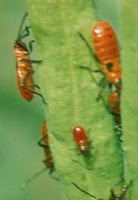
Large Milkweed Bug
Order:Hemiptera
Family:Lygaeidae
Genus:Oncopeltus
Species:Oncopeltus fasciatus

Identifying Characteristics: Adult is 9-18 mm long. Mature adults are orange with black spots.
Special Adaptations: Adults that survive winter mates in May-June when common milkweed plants have grown enough to provide shelter. Both nymphs and adults use the milkweed plant as a primary food source.

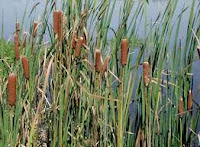
Cattail

Order:Poale
Family:Typhaceae
Genus:Typha
Species:Typha angustifolia

Identifying Characteristics: Leaves are erect, flat, and very narrow and 3'-6' tall. Flower is dense, fuzzy spike at end of stem. Males are lighter brown, females darker brown. Tall sword shaped leaves. Grows almost anywhere where soil remains wet, saturated or flood
ed during growing season.

Special Adaptations: Can grow in a variety of soil types.

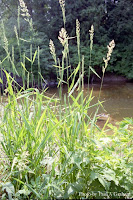
Reed Canarygrass

Order:Poales
Family:Poaceae
Genus:Phalaris
Species:Phalaris. arundinacea

Identifying Characteristics: Leaf blades are blue-green when fresh, straw colored when dry and stand about 4' tall. The flowers are borne on the stem high above leaves and are pinkish at full bloom.

Special Adaptations: Considered an invasive species in wetlands, especially in disturbed areas. When it invades a wetland it suppresses native vegetation and suppresses diversity. Grows well on poor soils and industrial areas.

Silky Dogwood

Order:Cornales
Family:Cornaceae
Genus:Cornus L.
Species:Cornus amomum

Identifying Characteristics:Large Shrub, 6'-10' high. Dark green ovate leaves, yellowish-whitish flowers that bloom in mid June, and bluish fruit that matures in September.

Special Adaptations: Does well in lake states, but poorly outside of its natural area. Does best in moist soils and does well in shade, but is not adaptable to droughty conditions.

Northern Leopard Frog

Order:Anura
Family:Ranidae
Genus:Rana
Species:Rana pipiens

Identifying Characteristics: Varies from green to brown on dorsal with large dark circular spots on its back, sides, and legs. Pale green stripe from eye to shoulder. Found in permanent ponds, swamps, marshes, and slow moving streams throughout forests, open, and urban areas. Eat a wide variety of animals including crickets, worms, flies and smaller frogs. They have large mouth and can even swallow birds and garter snakes.

Special Adaptations: Well adapted to cold temperatures. Do not distasteful skin secretions, so they rely on speed to evade predation.

Western Honey Bee

Order:Hymenoptera
Family:Apidae
Genus:Apis
Species:Apis mellifera

Identifying Characteristics:Fuzzy, hairy eyes, pollen carried in balls on legs, long radial cell near the front wing tip.

Special Adaptations: Not native to western hemisphere, but can survive in cold and hot weather due to heating and cooling of hives. Brought to western hemisphere by Spanish for honey.


Saturday, July 24, 2010

Lowland Forest Species


Jumpseed

Order:Caryophyllales
Family:Polygonaceae
Genus:Persicaria
Species:Persicaria virginiana

Identifying Characteristics:
-Alternate leaves that are oval or lance shaped. Small white flowers with 4 white petals placed along long, spiky stem. Dark spot on leaves which give the plant its nickname which
is "God's Thumbprint"
Special Adaptations:
-Can grow in a variety of light and soil conditions.

Clinton's Wood Fern

Order:Polypodiales
Family:Dryopteridaceae
Genus:Dryopteris
Species: Dryopteris clintoniana

Identifying Characteristics:
-Large, leathery, blueish-green colored fern with ladder-like formation. Longest fronds are in the middles of the plant. Lance shaped fronds, leafs and subleaflets are deeply lobed. Reddish fruit-dots along the back of plant. 3-7 per frond. Found in swampy-like areas.

Special Adaptations:
-Shade Tolerant

Virginia Creeper

Order:Vitales
Family:Vitaceae
Genus:Parthenocissus
Species:Parthenocissus quinquefolia

Identifying Characteristics:
-Leaves are compounded pinnately, composed of 5 leaflets. Leaflets are toothed which makes it easy to distinguish from poison ivy.

Special Adaptations:
-Kills other plants around it by blocking sunlight and limiting photosynthesis.

White-Tailed Deers

Order:Artiodactyla
Family:Cervidae
Genus:Odocoileus
Species:Odocoileus virginianus

Identifying Characteristics:
-White underside to the tail is easiest way to identify the deer. Coat is reddish-brown in spring and summer and turns gray-brown in fall and winter.

Special Adaptations:
-White underside of tail is used as signal of alarm. Can adapt to a variety of habitats.

Rough Speckled Shield Lichen

Order:
Family:
Genus:Punctelia
Species:Punctelia rudecta

Identifying Characteristics:
-Foliose Lichen: leaf like lobes. grey-green color, closely attached to bark or rock with tiny fine projections. White spots on upper surface that are pore-like.

Special Adaptations:
-Tolerant to pollution, will be found in cities and along roadsides where air pollution is high.

Fluffy Dust Lichen

Order:
Family:
Genus:Lepraria
Species:Lepraria lobaficans

Identifying Characteristics:
-Crustose Lichen. Granular looking. Light green in color.

Special Adaptations:
-

Red Belt Mushroom
Order:Polyporales
Family:Fomitopsidaceae
Genus:Fomitopsis
Species:Fomitopsis pinicola

Identifying Characteristics:
-Cap is hoof-shaped or triangular. Brown coloring with reddish band around the bottom of mushroom when young. Undersurface is whiteish with small pores. Easy to write on. Grows
on live and dead trees.

Special Adaptations:
-Inedible due to its woody texture.